

What is Roulette?
Roulette is a casino game built around a spinning wheel divided into numbered pockets. A small ivory ball is launched in the opposite direction; wherever it lands determines the outcome. Players place bets on a felt layout before the spin — predicting a single number, a group of numbers, a color, or a range — and are paid out at fixed odds if the ball settles on a matching pocket.
The name comes from the French word for little wheel. It is one of the oldest and most recognizable casino games in the world, present in virtually every land-based and online casino. Its appeal is simple: no skill is required to participate, the rules are quick to learn, and a single spin can pay up to 35 times the original stake.
A Brief History of Roulette
The modern roulette wheel is widely attributed to the French mathematician Blaise Pascal, who in the 17th century was attempting to design a perpetual-motion machine. He produced a weighted spinning wheel instead — an accidental prototype that gambling houses in Paris seized upon by the 1760s.
The single-zero format that defines European roulette today was introduced in 1843 by Francois and Louis Blanc at the Bad Homburg casino in Germany. Their innovation — removing one zero to lower the house edge and attract players — spread across the continent and eventually to Monte Carlo, which became synonymous with high-stakes roulette in the 19th century.
American casinos retained the double-zero format, which had appeared in early French wheels, giving the house a higher advantage. That division — single-zero European and double-zero American — remains the defining split in roulette today.
Online roulette launched in the mid-1990s alongside the first internet casinos, and live dealer roulette, streamed from real studios with human croupiers, became mainstream in the 2010s, closing the gap between digital convenience and physical atmosphere.
How Does Roulette Work?
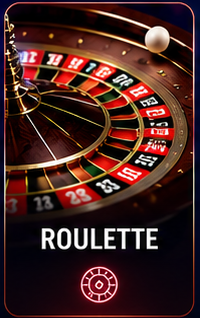
A Roulette wheel contains numbered pockets that alternate between red and black.
European Roulette
- 37 pockets (0-36)
- Single Zero (0)
- Lower house edge of 2.70%
American Roulette
- 38 pockets (0-36 plus 00)
- Higher house edge of 5.26%
European Roulette is generally considered the better option for players because it offers improved
Roulette Table Layout
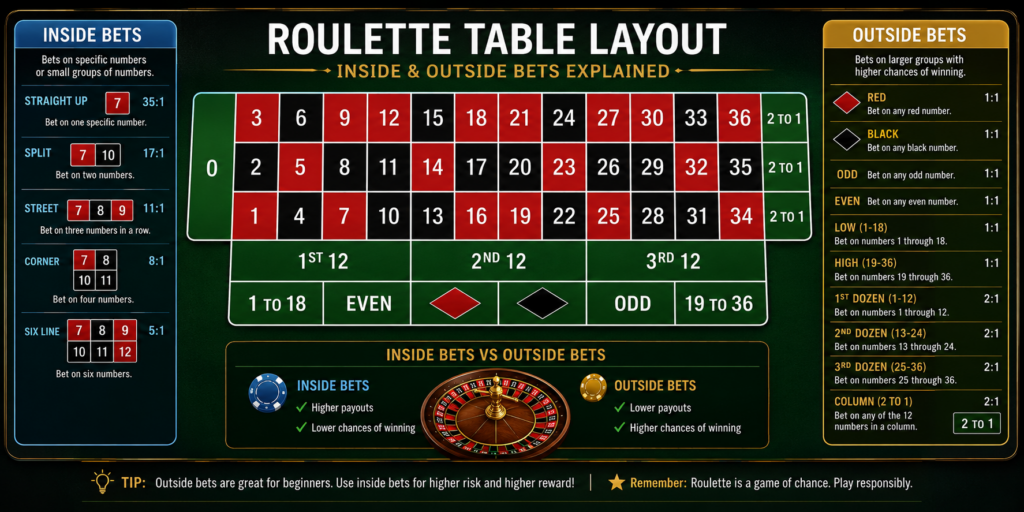
The Roulette table is divided into:
Inside Bets
Placed on specific numbers or small groups of numbers.
- Straight Up
- Split
- Street
- Corner
- Six Line
Outside Bets
Cover larger sections of the wheel.
- Red or Black
- Odd or Even
- High or Low
- Dozens
- Columns
Outside bets have a higher chance of winning but offer lower payouts.
How to Play Roulette
A round of roulette follows a fixed sequence. Understanding each step makes it easy to sit down at any table, physical or digital, with confidence.
Step 1 — Exchange cash for chips
At a live table, hand your cash to the dealer and receive colour-coded chips that are unique to you. Each denomination corresponds to a value you agree on before play starts. In online roulette, chip values are selected from the game interface.
Step 2 — Place your bets
The dealer (or software) opens the betting window. Place chips on the felt layout — on individual numbers, lines, columns, or the outside betting areas. Most tables display minimum and maximum stake limits for inside and outside bets separately.
Step 3 — No more bets
Once the ball is launched and passes a certain point on the wheel, the dealer calls “no more bets.” No further wagers are accepted.
Step 4 — The ball settles
The ball decelerates, bounces across the frets (the metal dividers between pockets), and settles into a numbered pocket. The dealer places a marker — called a dolly — on the winning number on the layout.
Step 5 — Payouts and collection
Losing bets are swept from the table first. Winning bets are paid out according to the fixed odds for each bet type. The dolly is removed and a new round begins.
EDITOR’S PICK FOR ROULETTE

New Players Only | Bonus Terms Apply
All Roulette Bets, Odds, and Payouts
Roulette bets divide into two categories: inside bets, placed on specific numbers or small groups on the inner grid, and outside bets, placed on larger categories in the border area of the layout. Called bets (also known as announced bets) are a third group, available mainly on European tables.
| Bet name | Type | Numbers covered | Payout | Probability (European) |
|---|---|---|---|---|
| Straight up | Inside | 1 | 35:1 | 2.70% |
| Split | Inside | 2 | 17:1 | 5.41% |
| Street | Inside | 3 | 11:1 | 8.11% |
| Corner (square) | Inside | 4 | 8:1 | 10.81% |
| Six-line | Inside | 6 | 5:1 | 16.22% |
| Column | Outside | 12 | 2:1 | 32.43% |
| Dozen (1st/2nd/3rd) | Outside | 12 | 2:1 | 32.43% |
| Red / Black | Outside | 18 | 1:1 | 48.65% |
| Odd / Even | Outside | 18 | 1:1 | 48.65% |
| Low (1–18) / High (19–36) | Outside | 18 | 1:1 | 48.65% |
| Voisins du Zéro | Called | 17 | Various | 45.95% |
| Tiers du Cylindre | Called | 12 | Various | 32.43% |
| Orphelins | Called | 8 | Various | 21.62% |
All probabilities above are for single-zero (European) roulette. In American roulette, divide by 38 instead of 37, which slightly reduces the probability of every bet and increases the house’s margin.
Understanding the house edge
Every bet in roulette pays less than the true mathematical odds. On a European wheel, a straight-up bet on a single number pays 35:1, but there are 37 pockets, meaning the true odds are 36:1 against you. That gap — one unit per 37 spins on average — is the source of the house edge. Across every bet type on a European table, this resolves to approximately 2.7%. American roulette, with two zero pockets, produces a house edge of approximately 5.26%.
European, American, and French Roulette
The three main variants share the same basic gameplay but differ in wheel layout and, critically, in rules that affect the house edge.
European Roulette
The standard form played across Europe and in most online casinos. One zero pocket (0). Numbers 1–36 alternate red and black around the wheel in a specific non-sequential order designed to balance high, low, odd, and even numbers.
House edge: 2.70%
American Roulette
Dominant in US casinos. Adds a double-zero (00) pocket, bringing the total to 38. The extra pocket raises the house edge nearly double without adding any player benefit. The five-number bet (0, 00, 1, 2, 3) is unique to this variant but carries the worst odds on the table.
House edge: 5.26%
French Roulette
Uses the single-zero European wheel but adds two player-friendly rules. La Partage: if the ball lands on zero, even-money bets lose only half their stake. En Prison: the bet is locked for the next spin instead of being taken. Either rule effectively halves the house edge on even-money wagers.
House edge (even money): 1.35%
Other variants worth knowing
Mini Roulette uses a 13-pocket wheel (0–12) and is common in online casinos as a lower-stakes format. Multi-wheel Roulette lets a single bet run simultaneously across multiple wheels. Lightning Roulette, a live-dealer variant from Evolution Gaming, adds randomly multiplied straight-up payouts up to 500:1 alongside standard bets.
Popular Roulette Strategies
Martingale Strategy
Double your bet after every loss.
Reverse Martingale
Increase your bet after wins.
Fibonacci Strategy
Follow the Fibonacci sequence when increasing wagers.
Flat Betting
Bet the same amount every spin for bankroll control.
Remember that no strategy can overcome the house edge.
Roulette Strategy: What Works and What Doesn’t
Roulette is a game of independent random events — the wheel has no memory of past spins. No betting system can alter the mathematical house edge, which is built into the payout structure. What strategy can do is manage your bankroll, adjust your risk profile, and extend or concentrate your playing time.
1. Choose European over American
The single-zero wheel offers a 2.70% house edge compared to 5.26%. Over a long session, this difference compounds significantly. If French rules are available, the edge on even-money bets drops to 1.35%.
2. Martingale (and its limits)
Double your stake after each loss on an even-money bet, return to base after a win. In theory, the first win recovers all prior losses. In practice, losing streaks outpace table maximums quickly — and a single streak of 7–8 losses, which is statistically common over a long session, requires a bet 128–256 times the opening stake.
3. Reverse Martingale (Paroli)
Double your stake after each win rather than each loss. This lets winning streaks compound while limiting the damage of losses to your original unit. Risk is bounded; gains are not. Suited to players who prefer shorter, more volatile sessions.
4. D’Alembert
Increase your stake by one unit after a loss and decrease it by one unit after a win. A gentler progression than Martingale — slower recovery but far less exposure. Effectively a flat-betting system with minor variance smoothing.
5. Set a loss limit before you start
Decide the maximum you are willing to lose in a session before sitting down, and leave when you reach it. This is less glamorous than a betting system but the only measure that consistently controls outcomes. The house edge means bankroll depletion is the expected long-run result; managing the rate of depletion is all that strategy can offer.
The gambler’s fallacy
The most persistent misconception in roulette is that past outcomes influence future spins. If red has hit seven times in a row, black is not “due.” Each spin is an independent event: the probability of red or black on the next spin is the same as on any other spin. Betting systems built on pattern recognition have no mathematical basis in roulette.
American vs European Roulette
| Feature | European Roulette | American Roulette |
| Zeroes | 1 | 2 |
| Numbers | 37 | 38 |
| House Edge | 2.70% | 5.26% |
| Best For | Most Players | Higher Risk Players |
European Roulette provides better long-term value.
Roulette Glossary
ACTION
The total amount wagered during a session.
BACKTRACK
The outer rim of the wheel where the ball initially travels.
CROUPIER
The casino employee who spins the wheel, launches the ball, and manages payouts.
DOLLY
The marker placed on the winning number after each spin.
EN PRISON
French rule that holds an even-money bet for the next spin when zero hits.
FRETS
The metal dividers separating the numbered pockets on the wheel.
LA PARTAGE
French rule returning half an even-money stake when the ball lands on zero.
LAYOUT
The felt betting surface on which players place their chips
One of the numbered compartments on the wheel where the ball can land.
RNG
Random Number Generator; the algorithm that determines outcomes in digital roulette.
TIERS DU CYLINDRE
A called bet covering twelve numbers on the opposite side of the wheel from zero.
VOISINS DU ZÉRO
A called bet covering seventeen numbers nearest to the zero on the wheel.
Tips for Playing Roulette Online
- Choose European Roulette whenever possible.
- Set a bankroll before you start.Understand payouts before betting.
- Use outside bets when learning the game.
- Take advantage of casino bonuses where permitted
- .Play free Roulette games before wagering real money.
Frequently Asked Questions About Roulette
From a pure house-edge perspective, even-money bets on a French table with La Partage or En Prison rules carry the lowest edge at 1.35%. On a standard European table, all bets carry the same 2.70% edge, so there is no strategically superior inside or outside bet — only a trade-off between payout frequency and risk.
In standard play, no. The house edge is structural and cannot be overcome with a betting system. Historical instances of consistent winning — wheel bias exploitation, sector targeting by skilled players — required physical wheels with manufacturing defects, a situation essentially eliminated by modern casino maintenance and digital wheels.
Inside bets are placed on individual numbers or small groups on the numbered grid, offering higher payouts and lower probability. Outside bets cover large categories — colors, odd/even, dozens, columns — with near 50/50 probability and 1:1 or 2:1 payouts. Both carry the same house edge on a European table.
Licensed online casinos use certified random number generators audited by independent testing bodies such as eCOGRA or iTech Labs. Live dealer roulette uses physical wheels streamed in real time, removing any RNG from the spin outcome. Choosing a casino with a recognised gambling licence (UK Gambling Commission, Malta Gaming Authority, etc.) provides regulatory assurance.
The double-zero pocket adds a 38th outcome without increasing any payout. A straight-up bet still pays 35:1 but now covers only 1 in 38 pockets rather than 1 in 37. That single extra pocket roughly doubles the house edge from 2.70% to 5.26%, reducing expected return on every bet type.
A called (or announced) bet covers a group of numbers defined by their position on the wheel rather than the layout. Common called bets include Voisins du Zéro (the 17 numbers near zero), Tiers du Cylindre (12 numbers opposite zero), and Orphelins (the 8 remaining numbers). They are standard on European and French tables and must be placed verbally before the betting window closes.
A European roulette wheel has 37 pockets: numbers 1–36 plus a single zero. An American wheel has 38 pockets: numbers 1–36 plus zero and double-zero. Mini roulette, found in some online formats, uses 13 pockets (0–12).