
Blackjack Online
Blackjack is one of the most popular casino games in the world and has remained a player favorite for decades. Known for its simple rules, fast-paced gameplay, and low house edge, Blackjack offers players one of the best chances to beat the casino when played correctly.
Whether you’re a complete beginner or an experienced casino player, Blackjack combines skill, strategy, and excitement to create one of the most rewarding casino gaming experiences available online.
What is Blackjack?
Blackjack is a card game played between the player and the dealer. The goal is simple: achieve a hand value closer to 21 than the dealer without going over 21.
Each player receives two cards, and the dealer receives two cards, with one card usually hidden. Players can then choose to draw additional cards or keep their current hand depending on the total value of their cards.
If your hand exceeds 21, you “Bust” and automatically lose the round.
CARD VALUES IN BLACKJACK
Understanding card values is the first step to mastering Blackjack:
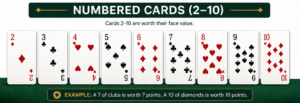
2–9 (Numbered Cards)
Worth their face value (e.g., a 7 counts as 7).
10, J, Q, K (Face cards)
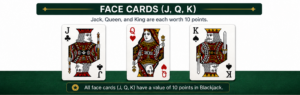
All worth 10 points. The most common value in any deck.
Ace
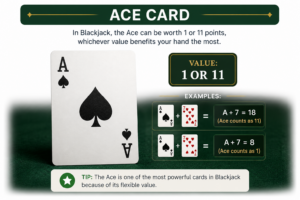
Worth 1 or 11 — whichever is more favourable to the hand.
RULES & HOW TO PLAY
A standard blackjack hand follows a clear sequence. Once you understand the flow, the game feels completely intuitive.
1. Place Your Bet💰
Before any cards are dealt, place chips in the betting circle. Minimum and maximum limits vary by table.
2. The Deal🃏
Each player receives two cards face up. The dealer takes one face up, one face down (the “hole card”).
3. Blackjack!⚡
An Ace + 10-value card on the deal is a “natural” blackjack. It typically pays 3:2 and beats a dealer 21.
4. Player Actions🖐️
Hit, Stand, Double Down, Split, or Surrender (if offered). Each choice shapes the hand’s outcome.
5. Dealer Plays🎰
After all players act, the dealer reveals the hole card and must hit until reaching 17 or higher.
6. Settlement 🏆
Hands closer to 21 win. Ties push (your bet is returned). Busts (over 21) lose automatically.
Player Actions Explained
| Hit | Request another card. You can hit as many times as you like until you stand or bust. |
| Stand | Keep your current hand and end your turn. |
| Double Down | Double your bet and receive exactly one more card. Best used on totals of 10 or 11. |
| Split | If you have two cards of the same value, split them into two separate hands, each with its own bet. |
| Surrender | Forfeit half your bet to exit a bad hand early. Not available at all tables. |
| Insurance | A side bet offered when the dealer shows an Ace. Pays 2:1 if the dealer has blackjack. Generally a poor bet for most players. |
Blackjack Strategy Basics
Unlike many casino games, Blackjack allows players to influence the outcome through strategic decisions.
Some basic strategy tips include:
- Always stand on 17 or higher.
- Hit on 8 or lower.
- Split Aces and 8s.
- Never split 5s or 10s.
- Double down on 11 when the dealer shows a weak card.
Using a Blackjack strategy chart can significantly reduce the house edge and improve your long-term results.
Basic Strategy Chart
Basic strategy is the mathematically optimal decision for every possible player hand vs. dealer upcard. Memorising it reduces the house edge to its theoretical minimum — roughly 0.5%. This condensed chart covers hard totals (no Ace, or Ace counted as 1).
Player Hand | 2 | 3 | 4 | 5 | 6 | 7 | 8 | 9 | 10 | A |
8 or less | ||||||||||
10 | ||||||||||
11 | ||||||||||
12 | ||||||||||
13-16 | ||||||||||
17+ |
H = Hit , S = Stand , D = Double Down
Chart applies to standard 6-deck blackjack, dealer stands on soft 17. Variations exist — always check house rules.
Key Strategy Rules to Memorise First
Always split Aces and 8s. Two Aces gives you two chances at 21. Two 8s (total 16) is the worst hand — splitting escapes it.
Never split 10s. A total of 20 wins most hands. Don’t break it up for greed.
Double down on 11 whenever the dealer shows 2–10. You have an excellent chance of drawing to 21.
Stand on hard 17+ regardless of the dealer’s upcard. The bust risk outweighs any potential gain.
Why Players Love Blackjack
Low House Edge
Blackjack offers one of the lowest house edges in the casino, often below 1% when played with optimal strategy.
Fast Gameplay
Rounds are quick, allowing players to enjoy more action and opportunities.
Skill-Based Decisions
Unlike slots, player choices matter and can directly impact results.
Multiple Variations
- Classic Blackjack
- European Blackjack
- Atlantic City Blackjack
- Vegas Strip Blackjack
- Multi-Hand Blackjack
- Live Dealer Blackjack
Blackjack Tips for Beginners
If you’re new to Blackjack, keep these tips in mind:
- Learn basic strategy before playing for real money.
- Even a rough knowledge of basic strategy significantly reduces the house edge. Print a card — most casinos allow it at the table.
- Start with low stakes & don’t chase losses
- Raising bets to recover losses is the fastest route to an empty wallet. Each hand is statistically independent.
- Set a bankroll and stick to it.
- Decide in advance what you’re willing to lose. This is money management’s most important rule.
- Choose games with favorable rules and 3:2 Blackjack payouts.
- Never sit at a 6:5 blackjack table. The lower payout on naturals costs you real money over time.
- Practice with free Blackjack games before wagering real money
- Pay attention to table rules
- Before playing, check: How many decks? Does dealer hit soft 17? Is doubling after splits allowed? These details all affect your edge.
Popular Blackjack Variations
European Blackjack
Dealer doesn’t peek for blackjack. No hole card dealt until all players act — increasing variance slightly.
Spanish 21
All 10s removed from the deck (not face cards). Compensates with bonus payouts for specific hands like 7-7-7.
Blackjack Switch
Players receive two hands and may switch the top cards between them. Dealer pushes on 22 instead of busting.
Pontoon
British variant with different terminology: “twist” (hit), “stick” (stand), “pontoon” for the 21 natural. Both dealer cards dealt face down.
Live Dealer Blackjack
Online tables with real dealers streamed in HD. Combines convenience with the social feel of a physical casino.
Free Bet Blackjack
The casino pays for doubles and splits on qualifying hands — but pushes on dealer 22 instead of paying. Popular in US casinos.
Play Blackjack Online
Blackjack remains one of the best casino games for players who enjoy a combination of strategy, excitement, and winning potential. With simple rules, numerous game variations, and some of the lowest house edges available, it’s easy to see why Blackjack continues to attract millions of players worldwide.
Whether you’re playing classic Blackjack, live dealer games, or modern variations, understanding the rules and applying smart strategy can help you get the most out of every hand.


Frequently Asked Questions
The goal is to beat the dealer by having a hand value closer to 21 without exceeding it. Going over 21 is called “busting” and is an automatic loss, regardless of the dealer’s hand.
With perfect basic strategy, the house edge is approximately 0.5% on a standard 6-deck game with favourable rules. Without strategy, it rises to 1.5–2% or more depending on player decisions.
Card counting is not illegal — it’s a mental skill. However, casinos are private businesses and can ask suspected counters to leave or bar them from playing blackjack. It’s not cheating in the legal sense, but it is unwelcome at most establishments.
The vast majority of recreational players will lose over time due to the house edge. Professional card counters can achieve a small positive edge, but it requires deep expertise, large bankrolls, discipline, and the ability to avoid detection. For recreational play, treat losses as the cost of entertainment.
A natural blackjack (an Ace and a 10-value card on the initial deal) typically pays 3:2, meaning a $10 bet wins $15. Some tables pay 6:5 — only $12 on a $10 bet — which significantly increases the house edge. Always choose 3:2 tables.
A “soft” hand contains an Ace counted as 11 (e.g., Ace-6 = soft 17). It can’t bust on the next hit since the Ace can revert to 1. A “hard” hand either has no Ace, or contains an Ace that must count as 1 to avoid busting (e.g., Ace-6-10 = hard 17).