
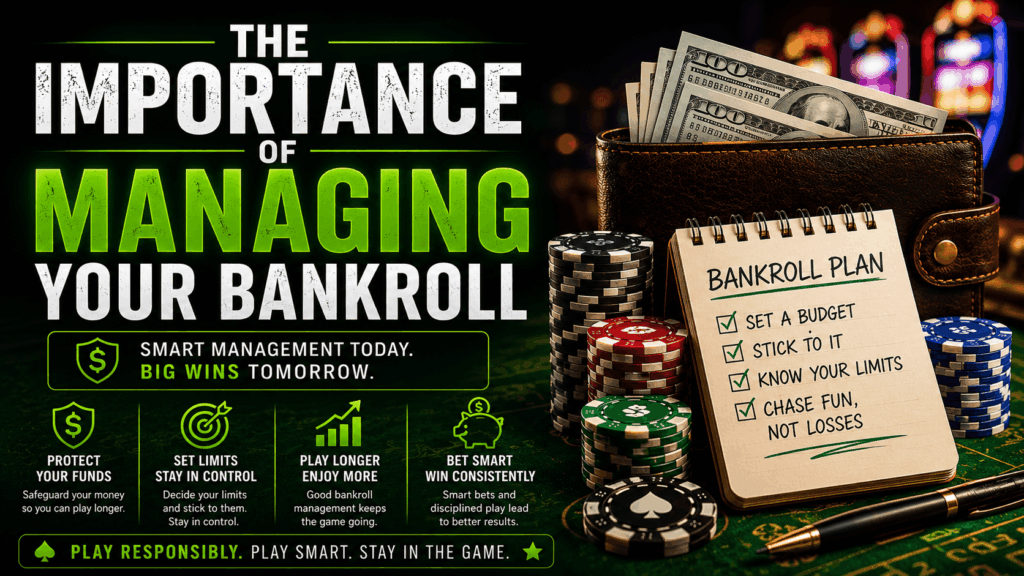
The Importance of Managing Your Bankroll
Talent, skill, and good decision-making can only take you so far if you don’t know how to protect your money. Whether you’re a poker player, a sports bettor, a trader, or someone who plays casino games for fun, bankroll management is the single most overlooked skill separating long-term survivors from people who go broke chasing a bad week. This post breaks down what bankroll management actually means, why it matters so much, and how to build a system that keeps you in the game. While luck always plays a role in casino games, managing your bankroll helps you stay in control, play for longer, and make smarter decisions. It’s one of the most important habits every casino player should develop.
In this guide, we’ll explain what bankroll management is, why it matters, and how you can use it to enjoy a more responsible and rewarding gambling experience.
What is Bankroll Management?
Your bankroll is the total amount of money you’ve set aside specifically for a particular activity — betting, trading, poker, whatever it may be. Bankroll management is the discipline of deciding, in advance, how much of that money you’re willing to risk on any single decision, and sticking to those limits no matter how confident you feel in the moment.
It’s not a strategy for winning. It’s a strategy for surviving long enough to let your actual skill or edge play out.
It should always be money that you can comfortably afford to lose without affecting your daily finances or financial responsibilities.
Your bankroll is not:
- Rent or mortgage money
- Grocery or utility funds
- Emergency savings
- Money borrowed from friends or lenders
Instead, think of it as your entertainment budget—similar to buying concert tickets or going out for dinner.
Why Bankroll Management Matters
Without a bankroll plan, it’s easy to:
- Chase losses after a bad session
- Spend more than you intended
- Make emotional betting decisions
- End your gaming session much sooner than expected
Good bankroll management helps you:
- Stay in control of your spending
- Reduce emotional decision-making
- Enjoy longer gaming sessions
- Protect your finances
- Make gambling more entertaining rather than stressful
Remember, casino games are designed with a built-in house edge, so managing your money is just as important as choosing which games to play.
Why It Matters More Than People Think
1. Variance Is Real, Even When You’re Right
Even a genuinely profitable strategy — a solid poker player, a sharp sports bettor, a disciplined trader — will hit losing streaks. Statistics guarantee it. The difference between someone who survives a downswing and someone who doesn’t usually isn’t skill. It’s whether they sized their bets so a bad stretch could never wipe them out.
Someone betting 20% of their bankroll on each wager can be knocked out by three or four bad results in a row, even with a genuine edge. Someone betting 2% can absorb a dozen losses without blinking.
2. It Removes Emotion From the Equation
Nothing wrecks decision-making like desperation. When your bankroll gets thin, every bet starts to feel like it has to work, and that pressure pushes people toward increasingly reckless decisions — bigger bets, worse odds, decisions made out of panic instead of logic. This is often called “tilt” in poker, but it shows up everywhere money and risk intersect.
Proper bankroll management keeps your stake sizes small relative to your total funds, so no single loss feels catastrophic. That emotional distance is what lets you keep making rational choices even after a rough patch.
3. It Forces Honest Self-Assessment
If you’re managing your bankroll properly, you’re constantly asking: Do I actually have an edge here? Is this bet size justified by my confidence and my results? That habit of scaling your risk to your actual evidence — rather than your gut feeling — tends to make you a better decision-maker across the board, not just at the table or the sportsbook.
4. It Keeps You in the Game Long Enough to Improve
Skill in any of these domains — trading, betting, poker — is built over volume. You need repetitions to learn, adjust, and refine your approach. Someone who blows through their bankroll in a weekend never gets that runway. Someone who manages it carefully gets to keep playing, keep learning, and keep improving their process over months and years.
Core Principles of Good Bankroll Management
🟢Set a Gambling Budget Before You Start
Before logging into an online casino, decide exactly how much you’re willing to spend.
For example:
- Weekly gambling budget: $100
- Session budget: $25
- Number of sessions: 4
Once you’ve reached your session limit, stop playing—even if you believe your luck is about to change.
🟢Separate your bankroll from your life savings.
This should be money you can afford to lose entirely without it affecting your rent, bills, or financial obligations. If it isn’t, you’re not managing a bankroll — you’re gambling with money that has a different job. Keep your gambling funds separate from your everyday finances.
Many players:
- Use a dedicated e-wallet
- Set monthly deposit limits
- Transfer only their gambling budget into a separate account
This makes overspending much less likely.
🟢Use a staking plan, not a feeling.
Common approaches include:
- Flat betting: risking a fixed percentage (often 1–3%) of your bankroll on each bet or hand, regardless of confidence level.
- Proportional/Kelly-based sizing: adjusting bet size based on your estimated edge, with more sophisticated players using a fraction of the Kelly Criterion to reduce volatility.
- Unit systems: defining a “unit” as a small percentage of your bankroll and sizing bets in units rather than dollar amounts, so your risk scales automatically as your bankroll grows or shrinks.
🟢Set stop-loss and stop-win limits.
Decide before you start playing how much you’re willing to lose in a session before you walk away — and consider a point where you’ll bank your winnings and stop too. Both extremes of emotion, despair and euphoria, lead to poor decisions.
🟢Track everything.
Keep records of your bets, sessions, or trades. Without data, you’re relying on memory, which tends to remember the wins more vividly than the losses. A simple spreadsheet showing your bankroll over time will tell you the truth your gut won’t. Consider recording:
- Deposits
- Withdrawals
- Wins
- Losses
- Time spent playing
- Games played
Over time, you’ll gain a better understanding of your gambling habits and whether you’re sticking to your bankroll strategy.
🟢Re-evaluate your bankroll periodically, not constantly.
Adjust your unit sizes as your bankroll grows or shrinks, but do this on a schedule (weekly or monthly) rather than reactively after every single result.
🟢Never chase losses.
Increasing your bet size specifically to win back what you’ve lost is one of the fastest ways to turn a manageable downswing into a wipeout. One of the biggest mistakes players make is trying to recover losses by increasing their bets.
Imagine losing $50 and deciding to double your next few wagers to win it back. If those bets lose too, the situation quickly becomes much worse.
Instead:
- Accept that losing sessions are part of gambling.
- Stick to your original budget.
- Come back another day with a clear mind.
The casino isn’t “due” to pay you because you’ve lost. Every spin, hand, or game round is independent.
🟢Choose bet sizes that match your Bankroll
A good rule is to keep each wager as a small percentage of your bankroll.
Example
| Bankroll | Recommended Bet Size |
|---|---|
| $50 | $0.25 – $0.50 |
| $100 | $0.50 – $1 |
| $250 | $1 – $2.50 |
| $500 | $2 – $5 |
Smaller bets help your bankroll last longer and reduce the impact of normal losing streaks.
🟢Take Advantage of Casino Bonuses
Casino bonuses can stretch your bankroll and provide extra playtime.
These may include:
- Welcome bonuses
- Deposit match bonuses
- Free spins
- Cashback offers
- Loyalty rewards
However, always read the bonus terms before claiming an offer. Pay attention to:
- Wagering requirements
- Maximum cash-out limits
- Eligible games
- Expiration dates
A bonus isn’t always as valuable as it first appears if the wagering requirements are difficult to complete.
🟢Avoid Emotional Gambling
Many poor decisions happen when players gamble while feeling:
- Angry
- Frustrated
- Stressed
- Tired
- Under the influence of alcohol
If you’re not in the right mindset, it’s better to take a break.
The best decisions are made with a clear head.
Games and Bankroll Management
Different casino games require different bankroll strategies.
Slots
Slots are highly entertaining but can be volatile. Some games pay smaller wins frequently, while others offer larger payouts less often. Choose your stake carefully and understand a slot’s RTP and volatility before playing.
Blackjack
Blackjack has one of the lowest house edges when played with optimal strategy, making disciplined bankroll management particularly effective over longer sessions.
Roulette
Whether you’re playing European or American Roulette, set betting limits and avoid increasing wagers dramatically after losses.
Poker
Poker requires one of the strictest bankroll strategies because variance can be significant, especially in tournaments. Many experienced players recommend maintaining a bankroll large enough to absorb extended downswings.
Common Bankroll Mistakes
Avoid these common pitfalls:
- Betting too much too quickly
- Chasing losses
- Increasing bets after every loss
- Gambling with borrowed money
- Ignoring win and loss limits
- Playing for too long without breaks
- Believing in “hot” or “cold” streaks
Recognizing these habits early can help you make better decisions.
Bankroll Management Checklist
Before every session, ask yourself:
- ✔️ Have I set a gambling budget?
- ✔️ Can I afford to lose this money?
- ✔️ Have I chosen sensible bet sizes?
- ✔️ Do I know my loss limit?
- ✔️ Do I have a win target?
- ✔️ Am I gambling for entertainment rather than income?
If you can answer “yes” to these questions, you’re starting from a responsible position.
Final Thoughts
Winning at a casino isn’t just about picking the right game or hitting a lucky streak—it’s also about managing your money wisely. A well-planned bankroll helps you stay in control, reduces the temptation to chase losses, and allows you to enjoy gambling as a form of entertainment rather than a way to make money.
By setting realistic budgets, sticking to sensible bet sizes, and using the responsible gambling tools offered by reputable online casinos, you’ll build healthier habits that make every session more enjoyable. Remember, the goal isn’t simply to win—it’s to play responsibly, protect your finances, and have fun along the way.
This post is for general informational purposes and isn’t financial advice. If gambling stops feeling fun or starts affecting your finances, relationships, or wellbeing, resources like the National Council on Problem Gambling (1-800-522-4700) are available for support