
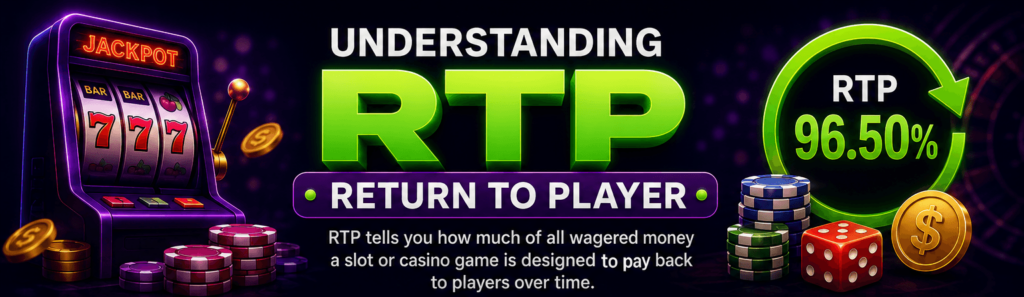
Understanding RTP: What “Return to Player” Actually Means
If you’ve spent any time browsing online slots or reading about casino games, you’ve probably run into the term RTP. It gets thrown around a lot in marketing copy (“98% RTP!”) but a lot of players don’t actually know what it means, how it’s calculated, or — most importantly — what it doesn’t tell you. Let’s break it down.
What is RTP?
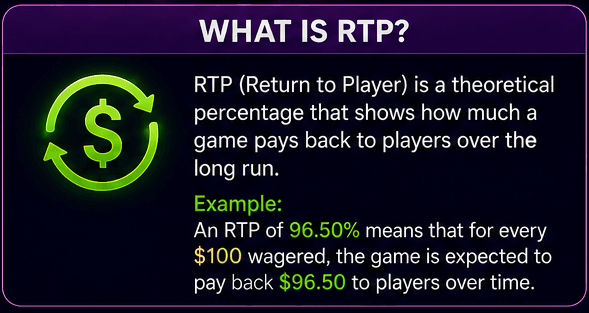
RTP stands for Return to Player. It’s a percentage that represents, on average, how much money a game is designed to pay back to players over a very large number of spins or rounds, relative to how much was wagered.
For example, if a slot machine has an RTP of 96%, that means for every $100 wagered on that game, the game is mathematically designed to return $96 to players over the long run. The remaining $4 is the house edge — the built-in advantage that keeps casinos profitable.
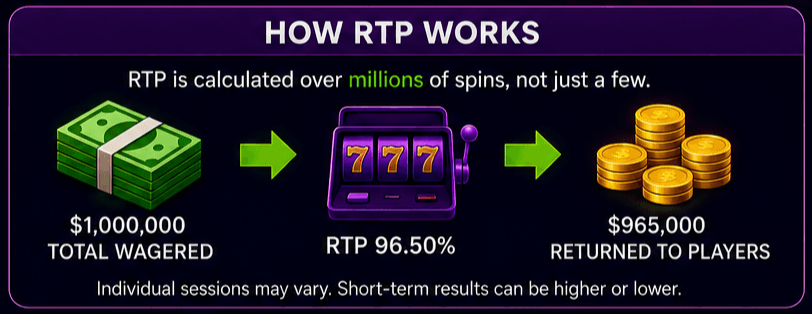
Here’s the key phrase in that definition: over the long run. RTP is a statistical average calculated across millions of simulated spins, not a promise about what will happen in any single session.
How RTP is Calculated
Game developers calculate RTP mathematically, based on the game’s paytable, symbol weightings, and win probabilities. It’s usually determined before a game is even released, using simulations that run millions or billions of virtual spins.
Once a game goes live, independent testing labs (like eCOGRA, iTech Labs, or GLI) often verify that the game’s actual long-term performance matches its stated RTP. This is part of what makes a licensed, regulated game trustworthy — the number isn’t just something the developer claims.
RTP vs. Volatility: Two Different Things
This is where a lot of confusion happens. RTP tells you how much a game pays back over time, but it says nothing about how that money is distributed. That’s where volatility (also called variance) comes in.
- Low volatility games pay out smaller wins more frequently.
- High volatility games pay out less often, but the wins can be much larger when they hit.
Two games can both have a 96% RTP, but feel completely different to play. A low-volatility 96% RTP slot might give you frequent small wins that keep your balance relatively stable. A high-volatility 96% RTP slot might drain your balance for long stretches before delivering one big payout that brings the average back up.
If you want a smoother, longer session, volatility matters just as much as RTP — sometimes more.
Common Misconceptions About RTP
“A 97% RTP means I’ll get 97% of my money back.” Not in any single session. RTP is a long-run average across the entire lifetime of a game, played by thousands or millions of people. In the short term — the 20 minutes you spend playing — results can swing wildly in either direction.
“The game is ‘due’ for a win because RTP hasn’t hit yet.” This is the gambler’s fallacy. Most slot outcomes are generated independently by a Random Number Generator (RNG), meaning each spin has no memory of previous spins. The game isn’t “catching up” to its stated RTP on any predictable schedule.
“Higher RTP always means a better game for me.” Higher RTP is generally better mathematically, but it’s not the whole picture. A high-RTP, high-volatility game could still result in a long losing streak. RTP is one factor among several — including volatility, bet size, and simple luck — that shape your actual experience.
Where to Find a Game’s RTP
Reputable online casinos and game developers typically publish RTP figures in the game’s information or “help” screen, often labeled as “Payout %,” “Theoretical RTP,” or similar. Land-based slot machines rarely display this figure to players, though jurisdictions often require casinos to report average payout percentages by machine category.
If a game doesn’t disclose its RTP anywhere, that’s worth treating as a red flag about the operator’s transparency.
Why RTP Matters When Choosing Games
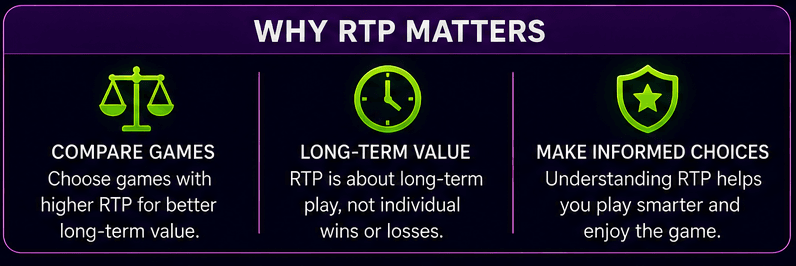
Even though RTP won’t predict what happens in your next session, it’s still a useful comparison tool. If you’re choosing between similar games, one with a 97% RTP is, mathematically, a better long-term bet than one with a 92% RTP. Over enough play, that five-percentage-point gap adds up.
That said, RTP should be one input into your decision-making, not the whole strategy. Set a budget, understand the volatility of the game you’re playing, and treat RTP as a useful signpost rather than a guarantee. Although RTP cannot predict what will happen during your next gaming session, it helps players compare games.
Benefits include:
- Better understanding of expected returns
- Easier comparison between games
- Helps identify player-friendly slots
- Useful when managing your bankroll
- Can improve long-term value when choosing games
Many experienced players prefer games with RTPs above 96% whenever possible.
What is considered a Good RTP?
Here’s a general guide:
| RTP | Rating |
|---|---|
| 98%+ | Excellent |
| 97% – 97.99% | Very Good |
| 96% – 96.99% | Good |
| 95% – 95.99% | Average |
| Below 95% | Lower than average |
Many popular online slots sit between 95% and 97% RTP.
RTP in Slot Games
Slots usually display their RTP in:
- Game information screen
- Paytable
- Help menu
- Casino review pages
Common slot RTPs include:
- 94%
- 95%
- 96%
- 96.5%
- 97%
Some providers also offer different RTP versions of the same game.
For example:
- 96.5%
- 95%
- 94%
Casinos can sometimes choose which RTP version to offer, so checking the game information before you play is always worthwhile.
RTP in Table Games
Many classic casino games offer significantly higher RTP than slots—especially when played with optimal strategy.
| Game | Typical RTP |
|---|---|
| Blackjack | Up to 99.5% |
| Baccarat (Banker Bet) | Around 98.9% |
| European Roulette | 97.3% |
| French Roulette | Up to 98.6% |
| Video Poker | Up to 99%+ (strategy dependent) |
Keep in mind that table game RTP often assumes players use the mathematically optimal strategy.
Tips for Using RTP Wisely
To make the most of RTP information:
- Choose games with RTPs of 96% or higher where possible.
- Compare similar games before playing.
- Check both RTP and volatility.
- Read the game’s paytable and bonus features.
- Stick to reputable casinos that clearly display RTP information.
- Manage your bankroll responsibly and avoid chasing losses.
Common RTP Myths
Myth: High RTP means I’ll win today.
False. RTP is calculated over millions of game rounds.
Myth: Slots become “due” for a payout.
False. Every spin is completely random and independent.
Myth: RTP changes depending on how much I bet.
Usually false. In most modern online slots, RTP remains the same regardless of bet size, although some bonus features or game mechanics can vary.
Myth: Casinos manually control when a slot pays out.
False. Licensed online casino games use certified RNG software and audited RTP settings. Results are random and not manually controlled by the casino.
Final Thoughts
Understanding the meaning of RTP is essential for making informed decisions when playing casino games. While it won’t predict the outcome of your next spin or hand, it provides a reliable indication of a game’s long-term payout potential.
The best approach is to combine RTP with other important factors—such as volatility, game features, and your bankroll—to choose games that match your playing style. Above all, remember that casino games are designed for entertainment, and outcomes are always random in the short term.
Frequently Asked Questions
RTP stands for Return to Player, which is the theoretical percentage of money a casino game returns to players over the long term.
Yes. A 96% RTP is generally considered a good return for an online slot and is a common benchmark used by experienced players.
No. RTP reflects long-term expected returns, not the size or timing of individual wins. Volatility has a greater influence on how often and how much a game pays during a session.
Blackjack (when played with optimal strategy), video poker, baccarat, and some roulette variants typically offer the highest RTPs in the casino.
Some game providers offer multiple certified RTP versions of the same slot, and casinos may choose among those versions. They cannot arbitrarily alter the RTP beyond the developer’s approved settings.