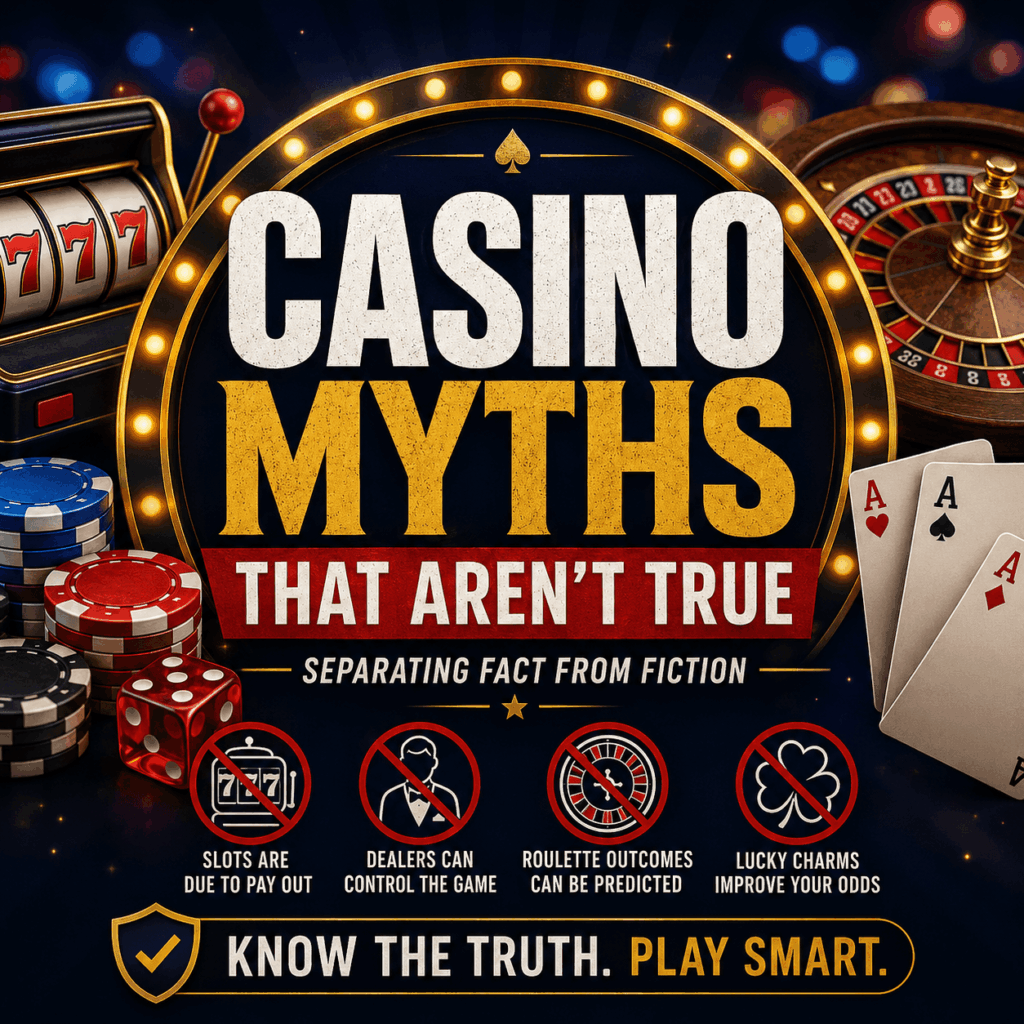
Casino Myths That Aren’t True
Walk onto any casino floor and you’ll hear them: whispered theories about “hot” machines, superstitions about lucky seats, and confident predictions about when a table is “due” for a win. Casinos are breeding grounds for myths, partly because randomness is genuinely hard for the human brain to process, and partly because the gambling industry has a long history of folklore passed from player to player.
While gambling should always be approached as entertainment rather than a way to make money, understanding how casino games actually work can help you make better decisions and avoid costly mistakes.
In this guide, we’ll debunk some of the most common casino myths and explain what really happens behind the scenes. Let’s separate fact from fiction.
❄️🔥Myth #1: Slot Machines Run on “Hot” and “Cold” Streaks
Perhaps no myth is more persistent than the idea that a slot machine can be “hot” (paying out generously) or “cold” (due to tighten up). Players will hop between machines chasing a hot streak or abandon a machine after a big win because they believe it’s “cooled off.”
In reality, modern slot machines run on a Random Number Generator (RNG) that produces thousands of number combinations per second, even when nobody is playing. Each spin is an independent event, statistically unrelated to the one before it. A machine that just paid out a jackpot has exactly the same odds on the very next spin as it did before. There’s no memory, no mood, no streak — just math.
🎉Myth #2: Slot Machines Are “Due” to Pay Out
The Myth:
If a slot machine hasn’t paid a jackpot in a long time, it’s due for a big win.
The Truth:
Every spin is completely independent of the previous one.
Modern online and land-based slot machines use a Random Number Generator (RNG) that creates thousands of random number combinations every second. The outcome is determined the instant you press the spin button.
That means:
- A machine that hasn’t paid in weeks isn’t any more likely to hit.
- A machine that just paid a jackpot can pay another immediately.
- Previous spins have absolutely no influence on future spins.
Reality: There is no such thing as a slot being “ready” to pay.
💸Myth #3: A Table Game Is “Due” for a Win
This one is a classic case of the gambler’s fallacy: the belief that if something hasn’t happened in a while, it becomes more likely to happen soon. If a roulette wheel lands on red ten times in a row, plenty of players will pile onto black, convinced it’s “due.”
But roulette wheels, dice, and cards don’t have memory either. Each spin of the wheel is independent of the last. The odds of red or black stay the same regardless of what happened three spins ago — or thirty. The only reason streaks feel meaningful is that our brains are wired to find patterns, even in truly random data.
🃏Myth #4: Casinos Can Change Games While You’re Playing
The Myth:
Casinos secretly lower your chances of winning once you’ve started playing.
The Truth:
Licensed online casinos cannot simply change a game’s RTP or odds while players are actively using it.
Game mathematics are built into the software by the game developer and are tested by independent auditing companies before release.
Changing these settings would require regulatory approval and updated game certification.
🎲Myth #5: Dealers Decide Who Wins
The Myth:
The dealer can choose whether players win or lose.
The Truth:
Dealers simply manage the game.
In blackjack, baccarat, roulette, and poker, dealers follow strict procedures.
They cannot:
- Change the order of cards
- Decide where the roulette ball lands
- Control dice rolls
- Pick who wins
Their role is simply to operate the game according to established rules.
🎰Myth #6: Online Casinos Rig Their Games
The Myth:
Every online casino manipulates games so players never win.
The Truth:
Reputable licensed casinos rely on certified software providers.
Game developers use independently tested RNG systems, while casinos are regularly audited to ensure fairness.
Of course, players should only choose licensed and trusted casinos.
↗️Myth #7: Betting More Increases Your Chances of Winning
The Myth:
Higher bets improve your odds.
The Truth:
Increasing your wager only increases the amount you can potentially win.
It does not change the mathematical probability of landing winning combinations.
For example:
- A $1 spin and a $10 spin have exactly the same chance of hitting the jackpot.
- The only difference is the payout size.
🔴Myth #8: You Can Predict Roulette Outcomes
The Myth:
After several black numbers, red is guaranteed next.
The Truth:
This is known as the Gambler’s Fallacy.
Each roulette spin is independent.
Even if black appears ten times in a row, the probability of red or black on the next spin remains essentially the same (excluding the green zero).
The wheel has no memory.
🍀Myth #9: Wearing Red (or Any “Lucky” Item) Changes Your Odds
Lucky charms, specific clothing colors, blowing on dice, entering through a certain door — these rituals are everywhere in casinos, and they’re comforting, but they have zero mathematical effect on outcomes. Card and dice games, along with RNG-based machines, don’t respond to what you’re wearing or which door you walked through. That said, if a lucky ritual helps you feel calm and play within your limits, the psychological benefit — while not statistical — isn’t nothing.
⏰Myth #10: Playing at Certain Times Gives Better Odds
The Myth:
Casinos loosen games late at night or on weekends.
The Truth:
Game odds remain the same regardless of:
- Time of day
- Day of the week
- Number of players online
- Holidays
The software doesn’t know whether it’s 2 a.m. or Saturday evening.
🤹Myth #11: Free Games Pay Less Than Real Money Games
The Myth:
Demo versions are programmed differently.
The Truth:
In most cases, demo games use the same mathematics and RTP as the real-money version.
The only difference is that no real money is wagered or won.
Demo mode is an excellent way to:
- Learn game features
- Understand bonus rounds
- Test betting strategies
- Play risk-free
🏆Myth #12: You Can Beat Every Casino Game With a Strategy
The Myth:
There is a guaranteed winning strategy.
The Truth:
No betting strategy can eliminate the built-in house edge.
Systems such as:
- Martingale
- Fibonacci
- Labouchere
- D’Alembert
may change how you manage your bankroll, but they do not alter the mathematical odds of the game.
The casino always maintains a long-term statistical advantage.
🎯Myth #13: Near Misses Mean a Jackpot Is Coming
The Myth:
If two jackpot symbols land and the third just misses, you’re getting closer to a big win.
The Truth:
Near misses are simply another random outcome.
They do not indicate that a jackpot is imminent or that the machine is “warming up.”
Every spin starts fresh.
😔Myth #14: Casinos Don’t Want Anyone to Win
The Myth:
Casinos never let players win.
The Truth:
Casinos pay out millions of dollars in winnings every day.
In fact, regular payouts are essential to building trust and keeping players engaged. While the house edge gives casinos an advantage over the long run, individual players can and do experience significant wins—including life-changing jackpots.
The key distinction is that these wins are random and cannot be predicted or guaranteed.
❌Myth #15: Card Counting Is Illegal
Movies love to portray card counters as criminals dodging casino security and law enforcement. In reality, counting cards in blackjack is not illegal in most jurisdictions. It’s simply a strategic use of publicly available information — the cards that have already been played — to make better betting decisions.
What is true is that casinos are private businesses and can refuse service to anyone they suspect of counting cards, including banning them from the property. So while you won’t go to jail for counting cards, you might get politely (or not so politely) escorted out.
💰Myth #16: The Casino Controls Payouts in Real Time
Some players believe that a casino employee, or some central system, can adjust a slot machine’s payout percentage on the fly — tightening it up when too many people are winning, for example. In heavily regulated gambling markets, this isn’t how it works. Payout percentages (also called Return to Player, or RTP) are typically set by the game’s software, tested and certified by independent regulatory bodies, and can’t be adjusted at the flip of a switch on the casino floor. Changing a machine’s programmed payout usually requires physically reconfiguring the machine, and doing so without proper licensing or disclosure would violate gaming regulations in most places.
♠️Myth #17: Betting Systems Like the Martingale Can Beat the House
The Martingale system — doubling your bet after every loss so that a single win recovers all previous losses plus a profit — sounds bulletproof on paper. In practice, it runs into two hard walls: table betting limits and the size of your own bankroll. A long enough losing streak (which is entirely possible with random outcomes) requires bets that grow exponentially, and most players hit either the table max or their own financial limit before the “guaranteed” win arrives. No betting system changes the underlying odds of a game; it only changes how you distribute your wins and losses.
🔷Myth #18: Casinos Pipe in Free-Flowing Cash to “Loosen Up” a Room
Some believe that casinos loosen slot machines near entrances or high-traffic areas to lure people in with visible wins, then tighten machines deeper in the casino. While it’s true that placement and visibility of winning machines can be a deliberate design choice, the extent of this practice is often exaggerated in popular myth. Payout percentages are regulated and disclosed (in aggregate) in many jurisdictions, and wild swings in RTP by machine location aren’t the norm in regulated markets.
💭Myth #19: Casinos Pump in Oxygen to Keep You Awake and Playing
This myth has circulated for decades: that casinos secretly pipe extra oxygen onto the floor to keep gamblers alert, energized, and unaware of time passing. It makes for a great conspiracy story, but it isn’t true. Casinos are large public buildings, and altering the oxygen content of the air throughout a massive, ventilated space would be impractical, expensive, and in many places, a violation of building codes and fire safety regulations.
What casinos do use are more mundane (and better-documented) atmosphere tactics — comfortable temperatures, pleasant lighting, ambient music, and layouts without clocks or windows. These genuinely can make time feel like it’s slipping away, but there’s no secret gas involved.
Why These Myths Continue to Exist
Many casino myths persist because our brains naturally look for patterns, even in random events. When players experience a winning streak after following a ritual or switching machines, it’s easy to connect the two—even if they’re unrelated.
Other factors that reinforce these myths include:
- Confirmation bias, where we remember events that support our beliefs and forget those that don’t.
- Stories shared by friends or online communities that become exaggerated over time.
- Superstitions that add excitement and personal meaning to the gambling experience.
Understanding the difference between coincidence and probability can help players make more informed decisions.
What Actually Matters When Choosing a Casino
Instead of relying on myths, focus on factors that genuinely affect your experience:
- Choose licensed and reputable casinos.
- Look for games with competitive RTP percentages.
- Read the bonus terms before claiming promotions.
- Set a gambling budget and stick to it.
- Play games you genuinely enjoy.
- Take advantage of demo games to learn the rules before wagering real money.
These practical steps won’t guarantee wins, but they can help you enjoy a safer and more informed gaming experience.
Final Thoughts
Casino games are designed around mathematics, probability, and randomness—not luck rituals, secret strategies, or hidden tricks. While it’s fun to hear stories about “hot” machines or lucky seats, understanding how casino games actually work can help you gamble more responsibly.
The best approach is to play for entertainment, know the rules of your chosen games, manage your bankroll wisely, and remember that every spin, card, and roll is governed by chance.
When you leave the myths behind, you’ll have a clearer understanding of what to expect—and you’ll be able to enjoy the casino experience with confidence.
Frequently Asked Questions
Yes. Licensed online casinos use independently tested Random Number Generators (RNGs) to ensure game outcomes are random and fair.
No. Licensed casinos cannot manually trigger jackpots or decide when individual machines pay out. Outcomes are determined by the game’s RNG.
No. While some strategies can help manage your bankroll or improve decision-making in skill-based games like blackjack, no strategy can guarantee consistent profits.
Generally, no. Demo versions typically use the same RTP and game mechanics as the real-money versions, allowing players to practice without financial risk.
Many myths stem from cognitive biases, superstition, and the human tendency to see patterns in random events. Understanding probability helps separate fact from fiction.